Research Problem
Safety-critical IoT deployments need anomaly detectors that provide pre-deployment false-positive-rate guarantees, not only post-hoc accuracy on a held-out test split.
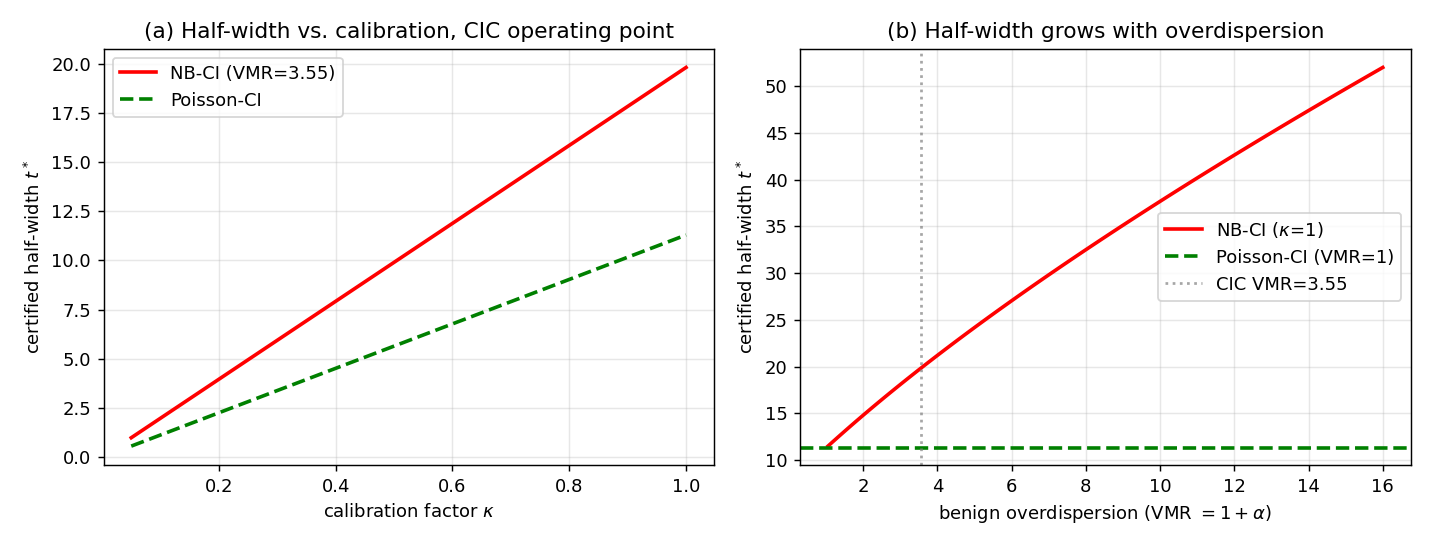
Existing certified detectors based on Poisson assumptions are limited by equidispersion, the assumption that per-window traffic counts have variance equal to their mean. Real IoT traffic is often strongly overdispersed because of bursty device behavior, protocol heterogeneity, and traffic aggregation.
When benign traffic is overdispersed but the certified interval is sized using a Poisson model, the interval can be mis-sized. This research addresses that gap by developing a certified detector designed for overdispersed IoT count traffic.
Core Contribution
The work introduces a Negative-Binomial Khinchine–Fubini concentration inequality for weighted sums of independent Negative-Binomial counts.
This moment bound is combined with Markov's inequality to construct certified confidence intervals whose half-width adapts to local dispersion. In the equidispersion limit, the framework recovers the Poisson–Touchard interval, allowing a direct comparison between Negative-Binomial and Poisson certified detectors.
The result is a certified anomaly detection framework that better reflects overdispersed IoT traffic while preserving the interpretability and formal false-positive-rate control of concentration-based detection.
Key Results
- Achieved AUC 1.000 on CIC IoT-DIAD 2024, compared with 0.965 for the Poisson certified baseline under the same calibrated setting.
- Improved detection on volumetric attacks, lifting F1 by up to 0.34 at a 1% false-positive-rate operating point.
- Confirmed on Gotham 2025 that the Negative-Binomial model fit overdispersed device traffic significantly better than the Poisson model on 98.5% of applicable devices.
- Preserved the certified false-positive guarantee at the κ = 1 operating point, with realized benign FPR remaining at 0.000 across validation settings.
Experimental Results
The NB-CI detector was evaluated on CIC IoT-DIAD 2024 as the primary benchmark and on Gotham 2025 as a cross-testbed stress test for overdispersed multi-device IoT traffic. The evaluation compares NB-CI against the Poisson certified baseline, a conformal anomaly detector, and a learned MLP baseline.
Detector Comparison on CIC IoT-DIAD 2024
On the identical CIC IoT-DIAD test stream, NB-CI matched the best raw detection performance while retaining a certified false-positive-rate guarantee that the learned baseline does not provide.
| Detector | AUC | pAUC0.05 | Realized FPR | Certification |
|---|---|---|---|---|
| NB-CI | 1.000 | 1.000 | 0.000 | Certified concentration bound |
| Poisson-CI | 0.967 | 0.948 | 0.000 | Certified concentration bound |
| Split Conformal | 0.511 | — | 0.0066 | Valid calibration, low power |
| MLP Baseline | 1.000 | — | 0.0100 | No pre-deployment certificate |
Cross-Testbed Stress Test
On the Gotham 2025 dataset, the Negative-Binomial model fit overdispersed device traffic significantly better than the Poisson model on 98.5% of applicable devices. On the non-trivial contested devices, NB-CI outperformed the Poisson detector by a median of 0.40 AUC, with the strongest gains appearing on highly overdispersed camera channels.
These results show that NB-CI extends certified IoT anomaly detection beyond the equidispersed Poisson setting, improving performance on overdispersed traffic while preserving formal false-positive-rate control.
Technical Approach
The detector models IoT traffic as overdispersed count data, estimates local Negative-Binomial behavior from benign windows, and constructs certified confidence intervals whose width adapts to the observed dispersion.
1. Count-Based Telemetry
Network traffic is aggregated into short time windows and represented through protocol-aware count features, with event counts used as the detection target.
2. Overdispersion Modeling
Instead of assuming that count variance equals the mean, the framework uses a Negative-Binomial model to represent bursty benign traffic whose variance-to-mean ratio exceeds one.
3. Local Dispersion Estimation
For each incoming window, nearby benign windows are used to estimate local Negative-Binomial parameters, allowing the interval width to adapt to local traffic variability.
4. Certified Interval Construction
The NB Khinchine–Fubini moment inequality is combined with Markov's inequality to produce a certified interval with a target false-positive-rate guarantee.
5. Calibration and Deployment
The certified κ = 1 setting preserves the formal guarantee, while a bootstrap-calibrated operating point recovers practical recall for deployment-oriented evaluation.
Roles and Contributions
As a co-author, I collaborated with Dr. Sana Spektor on the implementation, experimental evaluation, validation, and reproducibility of a certified anomaly detection framework for IoT cybersecurity. My work focused on translating the theoretical framework into a robust software implementation, conducting large-scale experimental studies, validating results across multiple datasets, preparing reproducible research artifacts, and contributing to the technical refinement of the submitted manuscript.
Research Implementation
Implemented and refined the certified anomaly detection pipeline by developing feature engineering workflows, integrating the proposed concentration inequality models, building reusable software modules, and supporting the end-to-end experimental infrastructure used throughout the study.
Experimental Evaluation
Designed and executed the experimental evaluation pipeline, including dataset preprocessing, benchmark implementation, matched false-positive-rate comparisons, cross-dataset validation, ROC analysis, and quantitative performance assessment across multiple attack scenarios.
Reproducibility and Research Software
Engineered a reproducible research package by modularizing the implementation into reusable Python components, creating configuration-driven experiment pipelines, automating notebook execution, organizing the repository for public release, and preparing reviewer-ready reproducibility materials.
Verification and Result Validation
Verified experimental outputs by auditing numerical results, validating consistency between notebooks, generated tables, figures, and manuscript values, investigating discrepancies, and ensuring that reported performance metrics accurately reflected the underlying experimental results.
Figures, Tables, and Research Outputs
Generated and validated publication-quality figures, tables, performance summaries, and experimental artifacts used throughout the manuscript, ensuring accuracy, consistency, and reproducibility across all reported evaluations.
Manuscript Development
Contributed to the technical preparation of the manuscript through result verification, methodological refinement, reproducibility documentation, technical writing, and collaborative review during the submission process for publication.
Research Artifacts
Supporting artifacts for this research include the submitted manuscript, experimental outputs, distributional-fit diagnostics, benchmark comparisons, and reproducibility materials. Public links will be added when they are appropriate to release.
Submitted Manuscript
Full research paper describing the Negative-Binomial Khinchine–Fubini concentration inequality, certified interval construction, and IoT anomaly detection evaluation.
Submitted, under full considerationExperimental Results
Evaluation outputs covering CIC IoT-DIAD 2024, Gotham 2025, NB-vs-Poisson comparisons, conformal baseline results, certified FPR validation, and latency benchmarking.
Summarized on this pageReproducibility Package
Code, configuration files, deterministic splits, result tables, and supplementary experiment outputs supporting the submitted manuscript.
Pending public release